01 EXPLORATION
Character Focus
A clearer stage for characters and skins. Familiar, but less social.
13% player preference
MINECRAFT CHINA · 2017–2024
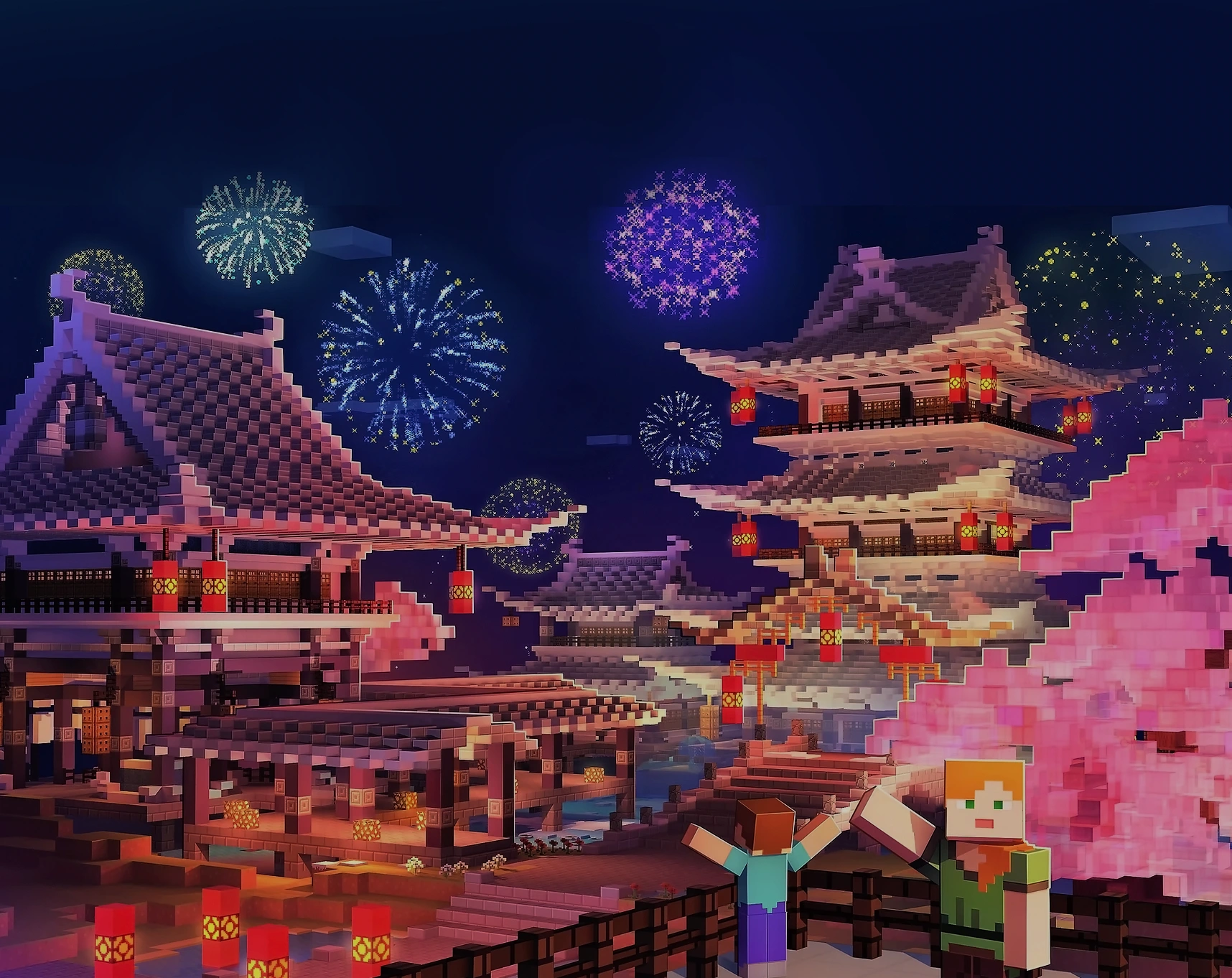
Turning the main menu into a place
players could make their own.
Lead Artist & Art Director · NetEase Games
01 · THE BEGINNING
I joined Minecraft China as its first artist and served as Lead Artist and Art Director from 2017 to 2024. Chinese players already knew the game as 我的世界, “My World.” We kept that familiar name while building an official visual identity and a surrounding experience for the local audience.
02 · THE CHALLENGE
Chinese mobile players expected a free, evolving experience built around friends and self-expression. Our challenge was to support those needs while preserving Minecraft’s creative identity.
I led art direction, visual standards, and UX quality across PC and mobile, connecting player research with the team’s production work.
After two years, the social experience needed attention: News Feed scored 3.5/5 and Friends System 3.4/5. Research into students’ apps, wallpapers, and play habits pointed toward an interface that felt dynamic, social, and alive.
We explored alternatives through the Double Diamond process, using shared visual references and team ideation before testing three prototypes.
03 · RESEARCH & EARLY EXPLORATION
The early hub changed from day to night with real time. Players could chat and visit friends, browse in portrait, then enter gameplay in landscape. The interface was becoming a social place—but after two years, player feedback showed there was more to solve.
We studied students’ everyday apps, phone wallpapers, and play habits. Friendship groups influenced how games spread; visual references revealed an appetite for clearer, more vibrant experiences.
These became the design criteria. The team used the Double Diamond process, shared sketches, and a “No list” to avoid overload, stale aesthetics, and novelty without functional value.
04 · THREE DIRECTIONS
We tested different balances of identity, social connection, and visual novelty.
| Direction | Preference | Average score | Style consistency |
|---|---|---|---|
| Character Focus | 13% | 3.78 | 3.70 |
| My Room | 46% | 4.24 | 4.21 |
| The Four Realms | 26% | 4.10 | 4.03 |
“It feels alive! I can imagine exploring and sharing this world with friends.”
Participant feedback and scores from the original presentation. Preference values total 85%; the source does not explain the remainder or specify test sample size. 46% is a preference share.
05 · THE SELECTED DIRECTION
My Room made navigation part of the social experience. Players could decorate, display items, and invite friends into a space that felt like theirs.
06 · FROM PROTOTYPE TO PRODUCTION
The selected direction became a reference for engine development. Fast prototypes, player verification, in-engine integration, and continued iteration connected the visual ambition to a repeatable production process. My role included visual benchmarks, UX quality across PC and mobile, themed content, production pipelines, and team mentorship.
Make the idea tangible enough to test.
Use player feedback before committing to implementation.
Bring selected features into the engine and improve them through shared workflows.
07 · OUTCOMES & REFLECTION
My Room led the displayed test results in preference, average score, and style consistency. We carried the validated features into engine development, then refined them through player feedback and shared production standards.
The lasting contribution was a way to connect visual ambition with evidence, so the team could keep improving a living game.
The presentation records 30 million downloads within two months of launch, 100 million users in the first year, and a later platform scale above 200 million users. These are wider project milestones across different periods, rather than results attributable to the menu redesign alone.
Selected collaborative work. Art direction and project narrative by Noah Z. Minecraft and related IP belong to their respective rights holders.